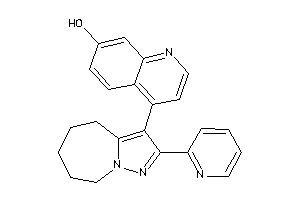
| In ZINC since | Heavy atoms | Benign functionality |
|---|---|---|
| July 18th, 2008 | 25 | Yes |
Popular Name: 4-(2-pyridin-2-yl-5,6-dihydro-4H-pyrrolo[1,2-b]pyrazol-3-yl)quinolin-7-ol 4-(2-pyridin-2-yl-5,6-dihydro-4H…
Find On: PubMed — Wikipedia — Google
CAS Number: 476474-11-0
| Type pH range | xlogP | Des A‑Pol Apolar desolvation (kcal/mol) | Des Pol Polar desolvation (kcal/mol) | H Don H-bond donors | H Acc H-bond acceptors | Chg Net charge | tPSA (Ų) | MWT Molecular weight (g/mol) | RB Rotatable bonds | DL |
|---|---|---|---|---|---|---|---|---|---|---|
| Ref Reference (pH 7) | 2.92 | 6.2 | -13.88 | 1 | 5 | 0 | 64 | 328.375 | 2 | ↓ |
| Hi High (pH 8-9.5) | 2.92 | 6.97 | -57.78 | 0 | 5 | -1 | 67 | 327.367 | 2 | ↓ |
| Mid Mid (pH 6-8) | 2.72 | 6.78 | -35.9 | 2 | 5 | 1 | 67 | 329.383 | 2 | ↓ |
| Lo Low (pH 4.5-6) | 2.92 | 6.46 | -36.2 | 2 | 5 | 1 | 65 | 329.383 | 2 | ↓ |
| Lo Low (pH 4.5-6) | 2.92 | 6.53 | -32.93 | 2 | 5 | 1 | 65 | 329.383 | 2 | ↓ |
| Code | Description | Organism Class | Affinity (nM) | LE (kcal/mol/atom) | Type |
|---|---|---|---|---|---|
| TGFR1-1-E | TGF-beta Receptor Type I (cluster #1 Of 1), Eukaryotic | Eukaryotes | 160 | 0.38 | Binding ≤ 10μM |
| Z80951-1-O | NIH3T3 (Fibroblasts) (cluster #1 Of 4), Other | Other | 420 | 0.36 | Functional ≤ 10μM |
| Uniprot | Swissprot | Description | Affinity (nM) | LE (kcal/mol/atom) | Type |
|---|---|---|---|---|---|
| TGFR1_HUMAN | P36897 | TGF-beta Receptor Type I, Human | 160 | 0.38 | Binding ≤ 1μM |
| TGFR1_HUMAN | P36897 | TGF-beta Receptor Type I, Human | 160 | 0.38 | Binding ≤ 10μM |
| Z80951 | Z80951 | NIH3T3 (Fibroblasts) | 420 | 0.36 | Functional ≤ 10μM |
| Description | Species |
|---|---|
| Downregulation of TGF-beta receptor signaling | |
| SMAD2/3 MH2 Domain Mutants in Cancer | |
| SMAD2/3 Phosphorylation Motif Mutants in Cancer | |
| TGF-beta receptor signaling activates SMADs | |
| TGF-beta receptor signaling in EMT (epithelial to mesenchymal transition) | |
| TGFBR1 KD Mutants in Cancer | |
| TGFBR1 LBD Mutants in Cancer | |
| TGFBR2 Kinase Domain Mutants in Cancer |