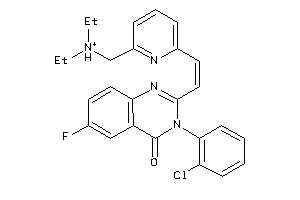
| In ZINC since | Heavy atoms | Benign functionality |
|---|---|---|
| September 29th, 2005 | 33 | Yes |
Popular Name: CP465022hydrochloride CP465022hydrochloride
Find On: PubMed — Wikipedia — Google
CAS Number: 199655-36-2
| Type pH range | xlogP | Des A‑Pol Apolar desolvation (kcal/mol) | Des Pol Polar desolvation (kcal/mol) | H Don H-bond donors | H Acc H-bond acceptors | Chg Net charge | tPSA (Ų) | MWT Molecular weight (g/mol) | RB Rotatable bonds | DL |
|---|---|---|---|---|---|---|---|---|---|---|
| Ref Reference (pH 7) | 4.09 | 3.15 | -46.79 | 1 | 5 | 1 | 52 | 463.964 | 7 | ↓ |
| Lo Low (pH 4.5-6) | 0.90 | 3.33 | -117.07 | 2 | 5 | 2 | 54 | 464.972 | 7 | ↓ |
| Code | Description | Organism Class | Affinity (nM) | LE (kcal/mol/atom) | Type |
|---|---|---|---|---|---|
| GRIA1-1-E | Glutamate Receptor Ionotropic, AMPA 1 (cluster #1 Of 3), Eukaryotic | Eukaryotes | 36 | 0.32 | Functional ≤ 10μM |
| GRIA2-1-E | Glutamate Receptor Ionotropic, AMPA 2 (cluster #1 Of 4), Eukaryotic | Eukaryotes | 74 | 0.30 | Functional ≤ 10μM |
| GRIA3-1-E | Glutamate Receptor Ionotropic, AMPA 3 (cluster #1 Of 2), Eukaryotic | Eukaryotes | 74 | 0.30 | Functional ≤ 10μM |
| GRIA4-1-E | Glutamate Receptor Ionotropic, AMPA 4 (cluster #1 Of 3), Eukaryotic | Eukaryotes | 74 | 0.30 | Functional ≤ 10μM |
| Uniprot | Swissprot | Description | Affinity (nM) | LE (kcal/mol/atom) | Type |
|---|---|---|---|---|---|
| GRIA1_RAT | P19490 | Glutamate Receptor Ionotropic, AMPA 1, Rat | 74 | 0.30 | Functional ≤ 10μM |
| GRIA1_MOUSE | P23818 | Glutamate Receptor Ionotropic, AMPA 1, Mouse | 0.1 | 0.42 | Functional ≤ 10μM |
| GRIA2_RAT | P19491 | Glutamate Receptor Ionotropic, AMPA 2, Rat | 0.1 | 0.42 | Functional ≤ 10μM |
| GRIA3_RAT | P19492 | Glutamate Receptor Ionotropic, AMPA 3, Rat | 0.1 | 0.42 | Functional ≤ 10μM |
| GRIA4_RAT | P19493 | Glutamate Receptor Ionotropic, AMPA 4, Rat | 0.1 | 0.42 | Functional ≤ 10μM |
| Description | Species |
|---|---|
| Activation of AMPA receptors | |
| Trafficking of GluR2-containing AMPA receptors | |
| Unblocking of NMDA receptor, glutamate binding and activation |